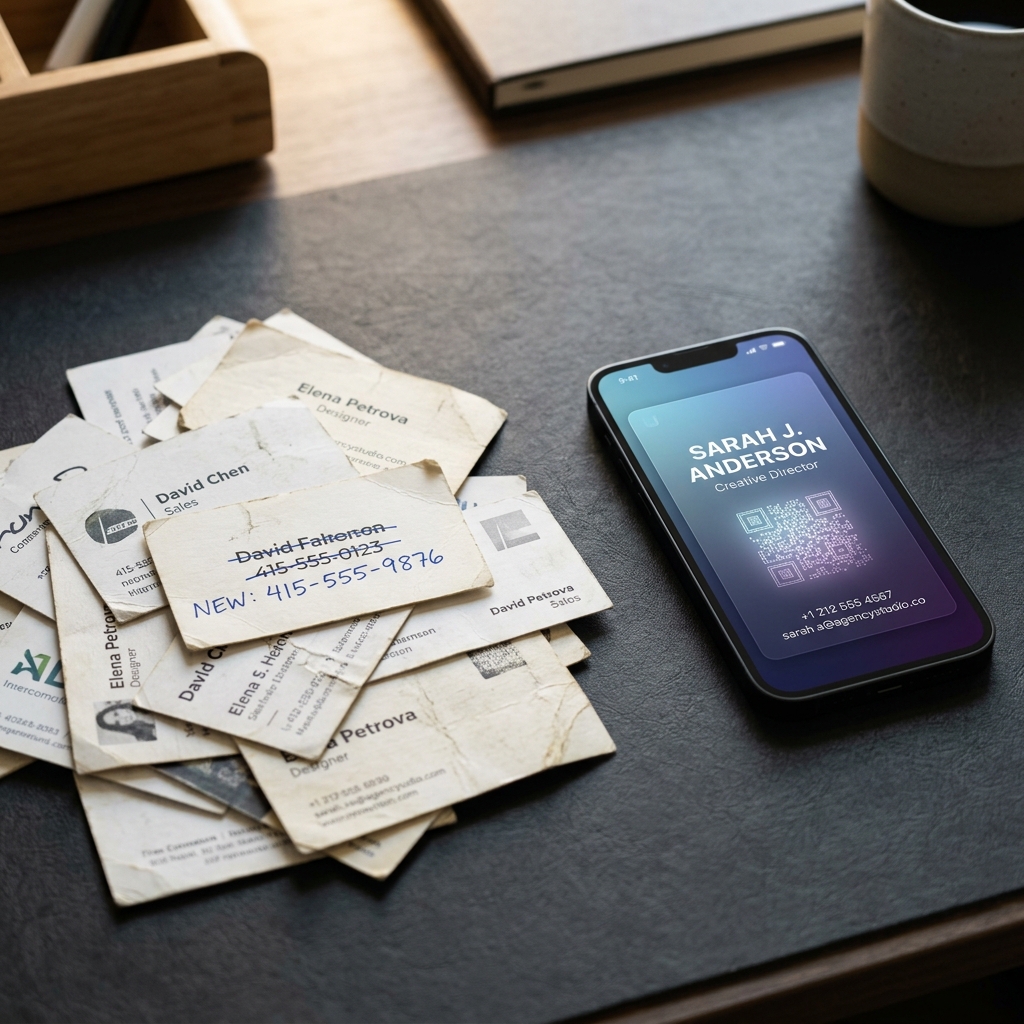
Every year, approximately 10 billion paper business cards are printed worldwide. Of those, studies estimate that nearly 88% are thrown away within a week of being received. That is a staggering volume of paper, ink, and money, all discarded into the bin alongside a networking opportunity that never materialized. If you have ever handed someone your card at a conference and then wondered why they never followed up, the card itself may be the problem.
The paper business card was invented in 15th-century Europe as a "visiting card" used by aristocrats to announce their arrival. For 500 years, the format barely changed. But the professional world has changed completely. In 2026, clinging to paper cards is like handing someone a fax number and expecting a callback. This article breaks down exactly why digital business cards are not just better, but necessary, and what the data says about where professional networking is heading.
The Hidden Cost of Paper Cards Most Professionals Ignore
Business cards look cheap on the surface. A standard box of 500 cards runs anywhere from ₹500 to ₹2,000 in India, or $20 to $80 internationally. But the real cost is in the reprints. Change your job title? Reprint. Get a new phone number? Reprint. Rebrand your freelance practice? Reprint. The average professional reprints their cards 2 to 3 times per year, and that does not account for the batch that got damaged, rained on, or left in the jacket you sent to the dry cleaner.
The true cost breakdown looks like this:
| Cost Category | Paper Card (Annual) | Digital Card (Annual) |
|---|---|---|
| Design & printing | ₹1,500 – ₹6,000 | ₹0 |
| Reprints after changes | ₹3,000 – ₹12,000 | ₹0 (edit in seconds) |
| Lost / damaged replacements | ₹500 – ₹2,000 | ₹0 |
| Analytics & follow-up data | Not possible | Built in |
| Environmental impact | ~10g CO₂ per card | Near zero |
When you factor in reprints, last-minute ordering fees, and the cards you toss because your designation changed, the annual cost of maintaining paper cards as a serious professional is often 3 to 5x higher than it appears at first glance.
What Happens to Paper Cards After They Leave Your Hand
There is a well-known statistic in the marketing world: 63% of people who receive a business card cannot remember within 48 hours where they received it or who gave it to them. The card gets shuffled into a pocket, dumped into a drawer, maybe photographed with a scanning app, and then the follow-up never happens because the friction between "I met this person" and "I contacted this person" is just high enough to let the moment pass.
Here is what typically happens to a paper card after it is handed over:
- It gets pocketed, often with 4 to 6 other cards from the same event
- It sits in a jacket or bag for days or weeks
- The owner cannot remember context when they rediscover it
- It either gets scanned into a contacts app (if the owner is disciplined) or discarded
- The contact is never made, and the networking opportunity is gone
A digital business card removes steps 1 through 5 entirely. When someone scans your Cardrosa QR code, your complete profile, with your name, title, email, phone, LinkedIn, portfolio, and every other link you choose to include, is accessible to them in under 3 seconds. There is no friction. There is no memory required. The connection happens in the moment it is supposed to happen.
"The best networking tool is the one with the least friction between meeting someone and staying connected to them."
The Environmental Argument Is Stronger Than You Think
Paper business cards are one of those small-scale environmental costs that gets overlooked because each individual card seems negligible. But at 10 billion cards printed per year globally, the math becomes alarming. Consider the scale:
- Trees: An estimated 7.2 million trees are cut down annually just to produce business cards worldwide.
- Water: Paper production is heavily water-intensive. Approximately 10 liters of water goes into producing a single sheet of standard business card stock.
- Ink waste: A significant portion of printing ink contains volatile organic compounds (VOCs) that are hazardous when cards are not disposed of properly.
- Landfill volume: Cards made with glossy UV coatings or lamination cannot be recycled and go directly to landfill.
Switching to a digital business card does not require a carbon offset purchase or a lifestyle overhaul. It is a single decision that eliminates your personal contribution to this problem entirely, while simultaneously making you a more effective networker. The environmental case and the professional case point in exactly the same direction.
Digital Cards Give You Data. Paper Cards Give You Nothing.
This is the single most undervalued advantage of digital business cards, and it is the one that separates serious professionals from everyone else. When you hand someone a paper card, the information flow stops there. You have no idea if they looked at it, if they visited your website, if they saved your number, or if the card is currently in a drawer or a bin.
With Cardrosa's analytics dashboard, every interaction with your digital card becomes a data point you can act on:
- Total views over time: See your networking activity visualized, with spikes after events, slowdowns between them, and long-term trend lines that show whether your digital presence is growing.
- Geographic breakdown: Know which cities or countries your card is being viewed from. Invaluable if you are trying to build a client base in a specific market.
- Device split: Understand whether your audience is primarily mobile (most are, at around 89%) so you can optimize your card layout and links accordingly.
- Link click tracking: Find out which of your links, such as LinkedIn, portfolio, phone, email or WhatsApp, actually get clicked, and which ones are being ignored.
This is the difference between networking blindly and networking intelligently. A freelance designer who knows that 73% of their card views are coming from Instagram can double down on that channel with confidence. A sales professional who sees a spike in views the day after a trade show has an evidence-based reason to send follow-up messages that day rather than waiting a week.
The NFC and QR Revolution Is Already Here
Two technologies have converged to make digital card sharing seamless for the first time: QR codes and NFC (Near Field Communication). QR codes became universally understood globally during the pandemic years, when restaurants, payments, and health check-ins all moved to QR-based flows. The average smartphone user in 2026 knows exactly what to do when they see a QR code. There is zero learning curve.
NFC tap-to-share takes it one step further. An NFC-enabled card or phone case, programmed with your Cardrosa link, allows you to share your complete digital profile with a tap. No camera required, no app download, nothing. The recipient's phone receives the link and opens it in their browser instantly. For senior professionals at high-stakes meetings where fumbling with a camera feels awkward, NFC is the cleanest possible handoff.
Who Is Already Using Digital Business Cards?
The early adopters of digital business cards were predictably tech workers and startup founders. But the demographic has broadened significantly. Cardrosa users span a wide range of professions:
| Industry | Primary Use Case | Most-Used Feature |
|---|---|---|
| Freelance Design & Creative | Portfolio + contact in one link | Custom theme, portfolio link |
| Sales & Business Development | Frictionless meeting follow-up | WhatsApp link, analytics |
| Startup Founders | Investor and partner outreach | Multiple links, analytics |
| Doctors & Healthcare | Clinic details, appointment booking | Location, consultation link |
| Academics & Researchers | Publication links, institutional bio | Google Scholar, ResearchGate links |
| Consultants | Personal brand + service menu | Calendly, LinkedIn |
The common thread across every profession is the same: one link that carries everything relevant, shareable in seconds, always current. The use case is not niche. It is universal.
Making the Switch: What You Lose and What You Gain
Switching to a digital business card is genuinely not a trade-off, but it is worth addressing the one objection that comes up repeatedly: "What about people who are not tech-savvy?" The honest answer is that in 2026, every professional with a smartphone has used a QR code. Food menus, UPI payments, event registrations. QR literacy is no longer a generational gap. The friction of scanning a code is now lower than the friction of typing out a URL manually.
What you give up: a tactile object, and the faint novelty of handing over a card with a satisfying snap. What you gain: a living, updatable, trackable, analytics-backed professional identity that works 24 hours a day, does not run out, and costs you nothing to maintain. For most professionals, this is not a hard decision once it is framed clearly.
Paper cards had a 500-year run. They served an era when updating information meant physically printing new ones and when tracking a connection meant writing a note in a Rolodex. That era is over. Your digital card is not just a replacement for paper. It is an upgrade to a fundamentally different kind of professional tool. Make the switch today and you will wonder why you waited.
Related posts

Your Digital Card Is Your Personal Brand: A Full Guide
A digital business card is not just a contact-sharing tool. It is the front door of your personal brand. Learn how to design, optimize, and leverage your Cardrosa card to land better clients, stronger referrals, and opportunities that find you rather than the other way around.
Plans and pricing
Start free with one digital business card, or upgrade to Pro for premium templates and advanced analytics.
View plans