
Most professionals think of a business card as a utility, a way to transfer contact details so a conversation can continue later. That framing undersells what a digital card can actually do. Your Cardrosa card is not a contact sheet. It is a curated first impression, a living portfolio, a networking engine, and a personal brand asset, all compressed into a single link that someone can open in 2 seconds on any device, anywhere in the world.
The difference between a professional who treats their digital card as a mere contact-sharing mechanism and one who treats it as a personal brand asset is measurable. It shows in the quality of inbound inquiries, the rate at which new connections convert to actual conversations, and the long-term compounding of a professional reputation that is always reachable, always current, and always positioned well. This guide covers every layer of that strategy, from design principles to link architecture to analytics-driven follow-up.
What a Personal Brand Actually Means in 2026
The phrase "personal brand" became so overused that many professionals have tuned it out. It is worth being precise about what it actually means in a professional context. Your personal brand is not your logo or your color palette. It is the answer to a specific question: when someone who has met you once tries to explain you to someone else, what do they say?
That answer is shaped by every touchpoint you control, including your LinkedIn headline, the way you communicate, the quality of your work, and critically, what someone finds when they look you up. A Cardrosa digital card is the one touchpoint you control completely and can optimize in real time. Unlike a LinkedIn profile (which lives on LinkedIn's terms and layout), your Cardrosa card presents exactly what you choose, in exactly the format you design, with no algorithmic interference.
The Anatomy of a High-Converting Digital Card
Not all digital cards are equally effective. The ones that generate actual follow-up share a consistent set of design and content decisions. Here is what each element of your Cardrosa card is doing from a personal brand perspective:
- Profile photo: A professional headshot, not a logo or a casual photo, signals that you take your professional identity seriously. It is also the primary visual anchor that helps people remember who you are days after they viewed your card.
- Headline / designation: Be specific and outcome-oriented, not just title-accurate. "Senior Designer at Acme" tells someone your rank. "Product Designer specializing in SaaS onboarding flows" tells them what you can do for them.
- Theme selection: Your visual theme communicates your professional category before a single word is read. A legal professional using a clean serif theme signals gravitas. A UX designer using a minimal monochrome theme signals taste. Cardrosa's theme catalog is designed with these professional signals built in. Choose the one that says what you want said before the viewer starts reading.
- Link hierarchy: Put your highest-value link first. For most professionals, that is either a portfolio, a LinkedIn profile, or a booking calendar. Put your contact methods (phone, email, WhatsApp) directly below. Every link below that should earn its place by being relevant to the person most likely to receive your card.
- Bio text: One or two sentences maximum. State your specialization, your key credential, and one specific thing you are known for. This is not a summary. It is a hook.
"Your digital card is not about telling people who you are. It is about making it effortless for the right people to reach you."
Choosing the Right Cardrosa Theme for Your Industry
Theme selection is the fastest way to either nail or undermine your personal brand positioning. The right theme creates instant visual alignment between what you do and how you present yourself. The wrong one creates cognitive dissonance. The viewer cannot quite articulate why, but something feels off.
| Professional Category | Recommended Theme Style | Why It Works |
|---|---|---|
| Tech / Engineering | Modern Dark, Minimal Monochrome | Signals clarity, technical precision, no-nonsense credibility |
| Design / Creative | Bold Gradient, Neon Accents | The card itself becomes a portfolio piece |
| Legal / Finance | Aristocratic Serif, Classic Clean | Communicates formality, trustworthiness, established authority |
| Healthcare | Clean White, Calm Blue tones | Signals cleanliness, approachability, professional care |
| Startup / Founder | Bold + Minimal hybrid | Balances ambition with focus. Looks funded but lean |
| Academia / Research | Classic Clean, Minimal | Defers to content over design. Credibility comes from substance |
Cardrosa's India-themed template deserves a special mention here. For professionals operating in domestic Indian markets, such as consultants, founders pitching to local investors, CAs and doctors, this theme functions as a cultural signal. It communicates rootedness, which is often a competitive advantage that imported, generic-looking cards fail to carry.
The Link Strategy: What to Include and in What Order
Most professionals make one of two mistakes with their digital card links. They either include too many (cluttering the card with every social profile they have ever created) or too few (just a phone and email, which defeats the purpose of going digital). The optimal link set is specific to your professional goal, and that goal should guide every inclusion decision.
Here is a framework for structuring your links based on your primary networking objective:
| Primary Goal | Essential Links | Optional Links | Skip These |
|---|---|---|---|
| Get hired (employee) | LinkedIn, Resume PDF, Email | GitHub, Portfolio site | Twitter, personal blog unrelated to field |
| Get clients (freelancer) | Portfolio, WhatsApp, Booking link | Instagram, Behance, LinkedIn | Personal social profiles |
| Build authority (thought leader) | Newsletter, LinkedIn, Primary content platform | Speaking bio, Podcast link | All dormant accounts |
| Raise funding (founder) | Pitch deck link, LinkedIn, Email | Product demo URL, Twitter | Generic company social |
The consistent principle across all these strategies: every link should have a specific job. If you cannot articulate in one sentence why a particular link is on your card, and what action you want the viewer to take when they tap it, remove it. Fewer, higher-quality links outperform comprehensive but unfocused lists every time.
Using Cardrosa Analytics as a Networking Intelligence Tool
Analytics are where digital cards separate completely from everything that came before them. The data available through Cardrosa's dashboard is not just a vanity metric. It is actionable intelligence you can use to make your networking meaningfully smarter.
Here is how to read and act on your analytics data in practice:
- Post-event spike analysis: After every networking event, conference, or client meeting, check your card views for the next 48 hours. A spike confirms people are following up. A flat line is data too. It tells you that event was not the right room for your profile.
- Geographic insight: If a meaningful share of your views is coming from a city or country you were not expecting, that is a signal worth investigating. Someone may be sharing your card in circles you are not aware of.
- Link click rate: If your portfolio link gets 200 views but only 12 clicks, that is a conversion problem. Either the link label is unclear, or the portfolio itself is failing on first impression. The data gives you a testable hypothesis to act on.
- Mobile vs desktop split: Knowing that 89% of your viewers are on mobile means your portfolio and any external sites you link to need to be mobile-optimized. If they are not, you are losing conversions at the last step.
- Time-of-day patterns: If your card gets most of its views between 9 PM and 11 PM, that tells you something about your audience. They are likely browsing after work hours, which should influence when you send follow-up messages.
The Follow-Up System That Actually Works
The majority of networking connections fail not at the first meeting but in the 48 hours afterward. The energy of the conversation fades, inboxes fill up, and the follow-up that felt urgent on Tuesday feels optional by Thursday. A data-informed follow-up system, built around your Cardrosa analytics, solves this by making the timing of follow-up an evidence-based decision rather than a guess.
The approach is straightforward:
- Check your analytics within 24 hours of any networking event. Who viewed your card? When? How long did they spend on it?
- Prioritize follow-ups to views that included link clicks. Those are the people who engaged beyond a surface-level glance. They are warm.
- Send a connection message that references the context of your meeting within that 24-hour window. Brief, specific, and actionable. Not "great to meet you", but "I mentioned the Figma resource you were asking about. Here it is."
- Archive contacts who viewed but did not click anything as a secondary follow-up group. They saw your card but did not engage. A softer, longer-form follow-up (a newsletter, a LinkedIn connection request) may bring them back into the funnel later.
This is the compounding effect of digital networking done right. Each event feeds data into a system that makes your next event more effective, your follow-up sharper, and your conversion rate higher over time. Paper cards cannot do any of this.
Long-Term Brand Building With a Single Link
The final and most underrated advantage of a digital card is its permanence. Your Cardrosa link does not change when your job changes, your title changes, your company changes, or your phone number changes. You update the card; the link stays the same. Every person who has ever received your card link still has access to your current, accurate, up-to-date profile.
Over a three-year career arc, this compounds into something significant. A professional who has been sharing the same Cardrosa link since 2023 has built an audience of every person they have ever met professionally. Any of them who visit that link today see exactly who that professional is now, not who they were three years ago. This is the digital equivalent of a permanent professional address. No paper card system can replicate it.
Your digital business card is not a feature of your personal brand. It is the foundation. It is the place everything else points to and the place every new connection begins. Design it with intention, optimize it with data, and treat it as the professional asset it is. The professionals building the strongest networks in 2026 are not the ones with the most contacts. They are the ones making every contact count, starting with the very first impression.
Related posts
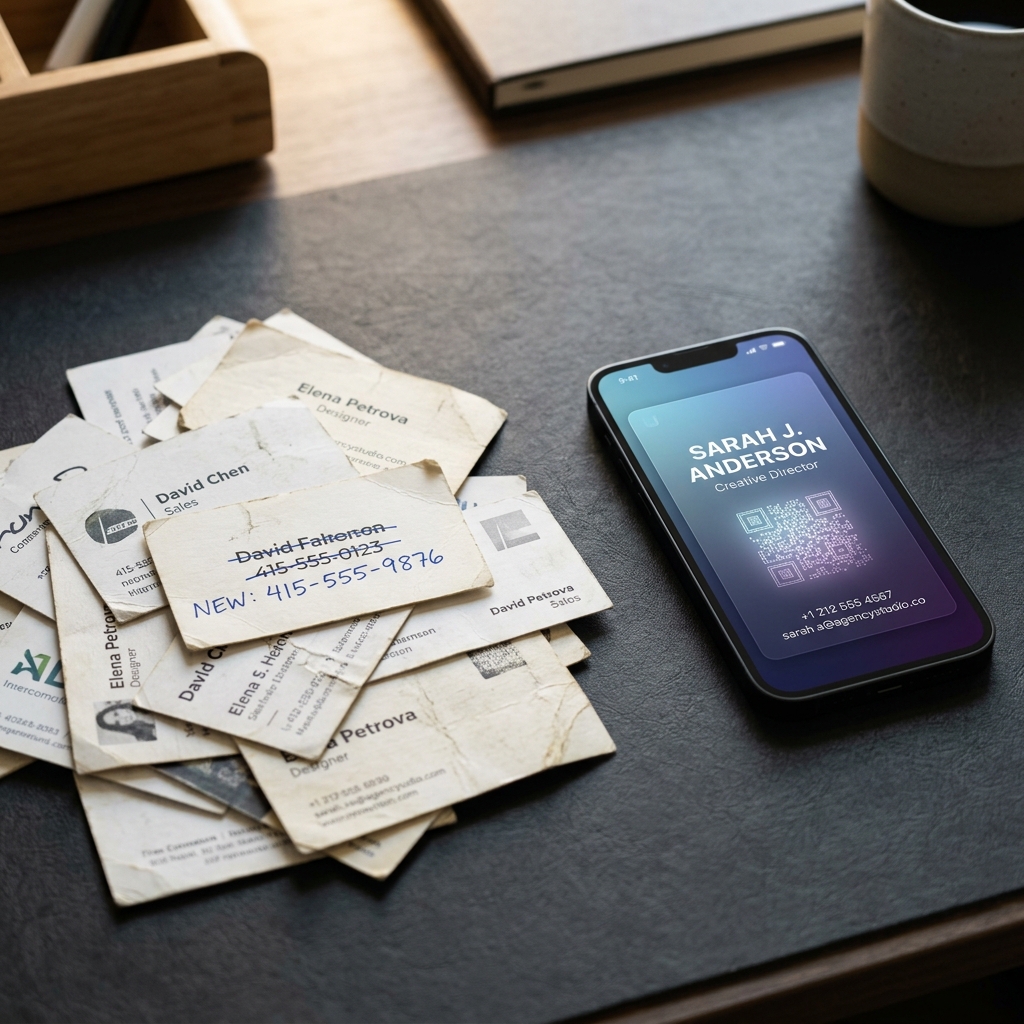
Paper Business Cards Are Dead: What Comes Next
Paper business cards have been a networking staple for over 300 years, but in 2026 they are a liability. Explore why the shift to digital business cards is not a trend but a permanent transformation, backed by real data and the professionals already ahead of the curve.
Plans and pricing
Start free with one digital business card, or upgrade to Pro for premium templates and advanced analytics.
View plans